
Gayatri Mantra Lyrics in English & Sanskrit: Meaning, Transliteration and Significance
The Gayatri Mantra is one of the most revered Vedic mantras in Hindu tradition. Its core verse appears in Rigveda 3.62.10 and invokes Savitr, the Vedic divine power associated with illumination and inspiration. In essence, the mantra asks that divine radiance illuminate and inspire our intellect, making it a profound prayer for wisdom, clarity and spiritual understanding.
Gayatri Mantra: Quick Facts
- Scriptural source: Rigveda 3.62.10
- Associated Vedic deity: Savitr or Savitā
- Vedic meter: Gayatri
- Central meaning: Meditation upon divine radiance and a prayer for illumination of the intellect
- Common recited form: Om Bhur Bhuvah Svah followed by the Gayatri verse
- Traditional use: Prayer, japa, meditation and Sandhya practice
- Also known as: Savitri Mantra
Gayatri Mantra in Sanskrit
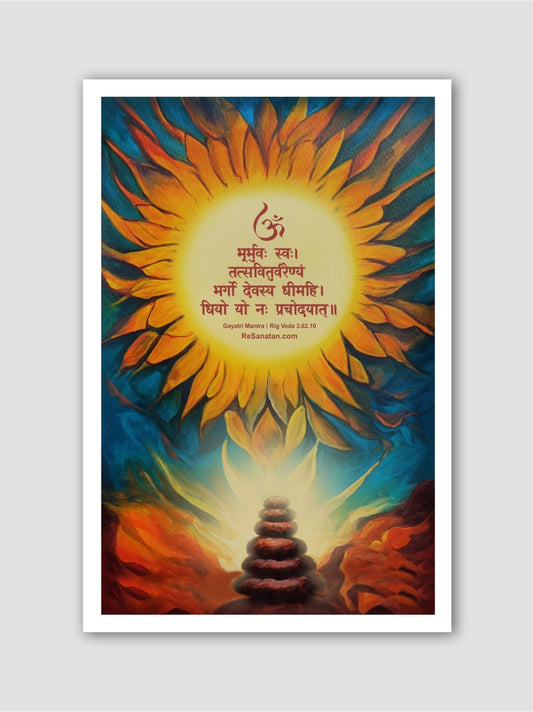
ॐ भूर्भुवः स्वः
तत्सवितुर्वरेण्यं
भर्गो देवस्य धीमहि
धियो यो नः प्रचोदयात् ॥
Gayatri Mantra Lyrics in English
Om Bhur Bhuvah Svah
Tat Savitur Varenyam
Bhargo Devasya Dhimahi
Dhiyo Yo Nah Prachodayat
Gayatri Mantra in Accurate Sanskrit Transliteration
Oṃ bhūr bhuvaḥ svaḥ
tat savitur vareṇyaṃ
bhargo devasya dhīmahi
dhiyo yo naḥ pracodayāt

What Does the Gayatri Mantra Mean in English?
A clear and concise English meaning of the Gayatri Mantra is:
“We meditate upon the excellent divine radiance of Savitr. May that divine light inspire and illuminate our intellect.”
Translations of Vedic Sanskrit can vary slightly because many Sanskrit words carry several related shades of meaning.
For example:
- Bhargo can convey radiance, brilliance or divine splendor.
- Dhimahi means “we meditate upon” or “we contemplate.”
- Dhiyo refers to intellect, understanding or thought.
- Prachodayat conveys the idea of inspiring, impelling, directing or illuminating.
The central prayer is therefore for divine illumination of human understanding.
Gayatri Mantra Meaning Line by Line
1. Om Bhur Bhuvah Svah
Om is the sacred syllable widely used at the beginning of Hindu prayers and Vedic recitation.
Bhur, Bhuvah and Svah are traditionally understood as the three great utterances or realms:
- Bhur — the earthly or physical realm
- Bhuvah — the intermediate or atmospheric realm
- Svah — the celestial or heavenly realm
Together, they place the prayer within a cosmic framework.
2. Tat Savitur Varenyam
Tat means “that.”
Savitur means “of Savitr.”
Varenyam conveys the sense of excellent, desirable, worthy or worthy of reverence.
This line directs contemplation toward the excellent divine radiance associated with Savitr.
3. Bhargo Devasya Dhimahi
Bhargo means radiance, brilliance or splendor.
Devasya means “of the divine” or “of the deity.”
Dhimahi means “we meditate upon.”
The line expresses meditation upon divine radiance.
4. Dhiyo Yo Nah Prachodayat
Dhiyo refers to our intellects, thoughts or understanding.
Yo means “who” or “which.”
Nah means “our.”
Prachodayat means “may inspire, impel, direct or illuminate.”
The final line is therefore a prayer that divine light inspire and guide our understanding.
Gayatri Mantra Word-by-Word Meaning
| Sanskrit Word | English Meaning |
|---|---|
| Om | Sacred primordial syllable |
| Bhur | Earthly or physical realm |
| Bhuvah | Intermediate or atmospheric realm |
| Svah | Celestial or heavenly realm |
| Tat | That |
| Savitur | Of Savitr |
| Varenyam | Excellent, desirable, worthy |
| Bhargo | Radiance, brilliance, divine splendor |
| Devasya | Of the divine/deity |
| Dhimahi | We meditate upon |
| Dhiyo | Intellects, thoughts, understanding |
| Yo | Who/which |
| Nah | Our |
| Prachodayat | May inspire, impel or illuminate |

👉 Shop/Gift Gayatri Mantra Wall Poster - Printed Wall Art on 300 GSM Art Paper
Where Does the Gayatri Mantra Come From?
The core Gayatri Mantra is found in Rigveda 3.62.10, placing it among the ancient Vedic hymns.
The verse invokes Savitr, a Vedic deity associated with illumination, inspiration and the life-giving solar principle.
This scriptural origin is important because the Gayatri Mantra is sometimes described online simply as a general meditation mantra.
It is more specifically:
a Vedic mantra from the Rigveda centered on Savitr and divine illumination.
Readers interested in other Sanskrit prayers and verses can also explore Resanatan's Popular Sanskrit Shlokas & Quotes With Meaning in English & Hindi.
Is “Om Bhur Bhuvah Svah” Part of the Original Gayatri Mantra?
There is an important distinction between the core Rigvedic verse and the familiar form commonly recited today.
The core verse in Rigveda 3.62.10 is:
Tat Savitur Varenyam
Bhargo Devasya Dhimahi
Dhiyo Yo Nah Prachodayat
In widespread traditional recitation, it is preceded by:
Om Bhur Bhuvah Svah
Bhur, Bhuvah and Svah are known as the Mahavyahritis, or great utterances.
Therefore, the version most devotees recognize combines Om and the Mahavyahritis with the Gayatri verse.
This also explains why different books or websites may present slightly different forms.
Why Is It Called the Gayatri Mantra?
“Gayatri” refers to the Vedic meter in which the core verse is composed.
Because the verse invokes Savitr, it is also traditionally known as the Savitri Mantra.
In later Hindu tradition, Gayatri is also personified as a divine feminine form associated with sacred knowledge and Vedic wisdom.
For understanding the original Vedic verse, however, the key relationship is:
Gayatri Mantra → Rigveda 3.62.10 → Gayatri meter → Savitr → illumination of the intellect
Who Is Savitr in the Gayatri Mantra?
Savitr, also written Savitā, is a Vedic deity associated with the illuminating and impelling power connected with the Sun.
The Gayatri Mantra asks us to contemplate the divine bhargas, or radiance, of Savitr and asks that this illumination inspire our intellect.
This gives the mantra its enduring spiritual message:
May divine light illuminate our understanding.
Is the Gayatri Mantra a Prayer to the Sun?
The answer requires some nuance.
Savitr has a strong solar association in Vedic tradition, so the Gayatri Mantra is certainly connected with solar imagery and radiance.
However, reducing the mantra simply to “a prayer to the physical Sun” misses much of its meaning.
The prayer contemplates divine radiance and asks that it inspire and illuminate human intellect.
The visible Sun therefore also becomes a powerful symbol of light, knowledge and spiritual illumination.

👉 Download Gayatri Mantra - Printable Digital Download - Wall Art PDF
Spiritual Significance of the Gayatri Mantra
The Gayatri Mantra has held an important place in Hindu spiritual practice for centuries.
Its significance can be understood through several themes.
1. Prayer for Illumination
The mantra asks for illumination of the intellect rather than focusing primarily on material possessions.
Its central request is for clearer understanding and wisdom.
2. Meditation on Divine Radiance
The devotee meditates upon divine radiance associated with Savitr.
Light naturally becomes a symbol of the movement from darkness and ignorance toward knowledge and awareness.
3. Cultivation of Wisdom
The mantra asks that our dhiyo — our intellects or understanding — be inspired.
It therefore places wisdom and right understanding at the heart of spiritual practice.
4. Spiritual Discipline
Regular mantra recitation can become part of a disciplined devotional or contemplative routine.
Traditional Hindu practice emphasizes not merely repetition but attention, devotion and understanding.
5. Reminder of Dharmic Living
A prayer asking for enlightened understanding can also serve as a reminder to approach our choices, responsibilities and relationships thoughtfully.
Traditional claims about spiritual benefits should be understood within the context of Hindu belief and practice rather than as guaranteed medical or material outcomes.
How Do You Pronounce the Gayatri Mantra?
For English-speaking beginners, it may help to break the mantra into shorter phrases:
Om Bhoor Bhoo-vah Svah
Tat Sa-vi-tur Va-ren-yam
Bhar-go De-va-sya Dhee-ma-hi
Dhee-yo Yo Nah Pra-cho-da-yaat
This is only a simplified pronunciation guide.
Sanskrit contains sounds that cannot be represented perfectly using ordinary English spelling.
Those who want to learn precise Sanskrit or Vedic pronunciation should ideally learn from a knowledgeable Sanskrit or Vedic teacher.
How Is the Gayatri Mantra Traditionally Chanted?
Practices vary among Hindu families, sampradayas and lineages.
A simple devotional approach may include:
- Sit in a clean and quiet place.
- Calm the breath and mind.
- Recite the mantra slowly and attentively.
- Reflect upon its meaning while chanting.
- Avoid rushing simply to complete a particular number.
- Maintain consistency if incorporating it into your daily spiritual practice.
Traditional Sandhya practice can involve more specific procedures.
Someone who follows a particular initiated or lineage-based tradition should follow the guidance of their Guru or teacher.
What Is the Best Time to Chant the Gayatri Mantra?
Gayatri recitation is traditionally associated with Sandhya, particularly the transitional periods of the day.
Morning and evening are therefore commonly associated with Gayatri practice.
Many practitioners recite the mantra:
- around sunrise;
- during morning prayer;
- around sunset;
- during meditation;
- as part of Sandhyavandanam or another established practice.
Detailed practices vary between Hindu traditions.
How Many Times Should the Gayatri Mantra Be Chanted?
Different traditions follow different numbers.
Some practitioners use a mala and chant the mantra 108 times.
The number 108 itself has extensive spiritual significance across Hindu traditions.
You can explore this further in Resanatan's guide to The Sacred Number 108 in Hinduism: Significance and Spiritual Importance.
However, beginners should not feel that spiritual value depends solely upon completing a particular number.
Attentive recitation with understanding is more meaningful than mechanical repetition simply to reach a count.
Gayatri Mantra and Meditation
The Gayatri Mantra can provide a powerful focus for contemplative meditation.
Instead of repeating the sounds automatically, practitioners can reflect upon the central idea:
divine radiance illuminating the intellect.
This brings together:
- mantra;
- sound;
- concentration;
- meaning;
- contemplation.
Readers interested in the broader relationship between mantra practice, attention and mental well-being can also read Resanatan's Can Mantra Chanting Reduce Anxiety? Hindu & Vedic Mantras Explained Scientifically.
That article explores mantra practice more broadly, while this page remains specifically focused on the Gayatri Mantra lyrics, meaning, origin and significance.
Bring the Gayatri Mantra Into Your Prayer or Meditation Space
For devotees who would like to keep the mantra visible in their home, Puja room or meditation area, Resanatan offers several Gayatri Mantra devotional art options.
Gayatri Mantra Wall Frame
A framed Gayatri Mantra artwork can be displayed in a prayer room, meditation corner or other peaceful space in the home.
Shop Gayatri Mantra Wall Frame – Framed Wall Art
Gayatri Mantra Wall Poster
For those who prefer a traditional printed format, the Gayatri Mantra is also available as wall art printed on 300 GSM art paper.
Shop Gayatri Mantra Wall Poster – Printed Wall Art
Gayatri Mantra Printable Digital Download
For readers in the United States or anywhere worldwide who want immediate access, Resanatan also offers a Gayatri Mantra Printable Digital Download Wall Art PDF.
The digital format can be downloaded and printed locally for a prayer room, meditation area, home or thoughtful spiritual gift.
Download Gayatri Mantra Printable Digital Wall Art PDF
Displaying the Gayatri Mantra should not be treated as a substitute for understanding or spiritual practice.
Instead, devotional art can serve as a visual reminder to pause, reflect and remember the mantra's central prayer for wisdom and illumination.
Frequently Asked Questions About the Gayatri Mantra
What is the Gayatri Mantra?
The Gayatri Mantra is a revered Vedic mantra whose core verse appears in Rigveda 3.62.10. It invokes Savitr and asks that divine radiance illuminate and inspire human understanding.
What are the Gayatri Mantra lyrics in English?
A commonly used English transliteration is:
Om Bhur Bhuvah Svah
Tat Savitur Varenyam
Bhargo Devasya Dhimahi
Dhiyo Yo Nah Prachodayat
What is the simple meaning of the Gayatri Mantra?
Its central meaning can be expressed as:
We meditate upon the divine radiance of Savitr. May that divine light inspire and illuminate our intellect.
Which Veda contains the Gayatri Mantra?
The core Gayatri Mantra occurs in the Rigveda, Mandala 3, Hymn 62, Verse 10 — Rigveda 3.62.10.
Who is the deity of the Gayatri Mantra?
The Rigvedic verse invokes Savitr or Savitā, a Vedic deity associated with illumination, inspiration and solar radiance.
Is Gayatri Mantra dedicated to the Sun?
Savitr has a strong solar association, but the mantra should not be understood merely as worship of the physical Sun.
Its deeper focus is divine radiance and the illumination of human intellect.
Is Om Bhur Bhuvah Svah part of Rigveda 3.62.10?
The core verse of Rigveda 3.62.10 begins with Tat Savitur Varenyam.
In widespread traditional recitation, Om Bhur Bhuvah Svah precedes the Gayatri verse.
What does “Tat Savitur Varenyam” mean?
It refers to the excellent or worthy divine radiance associated with Savitr upon which the devotee meditates.
What does “Dhiyo Yo Nah Prachodayat” mean?
It expresses a prayer that the divine may inspire, direct or illuminate our intellects and understanding.
Why is it called the Gayatri Mantra?
The verse is composed in the Gayatri meter. Because it invokes Savitr, it is also traditionally known as Savitri.
Can beginners chant the Gayatri Mantra?
The Gayatri Mantra is widely known and recited. However, formal practices and lineage-specific rules can differ, so those following a particular tradition should respect the guidance of their Guru or teacher.
Can the Gayatri Mantra be chanted during meditation?
Many devotees incorporate Gayatri into prayer, japa and meditation. Specific methods vary according to tradition.
How many times should Gayatri Mantra be chanted?
Some traditions use counts such as 108 repetitions, while others incorporate the mantra into Sandhya practice. Meaningful and attentive recitation is more important than mechanically pursuing a number.
Can Gayatri Mantra chanting cure health conditions?
The Gayatri Mantra is a spiritual and contemplative practice. It should not be presented as a medical treatment or cure and should not replace appropriate healthcare.
Understanding the Gayatri Mantra Beyond Its Translation
The lasting power of the Gayatri Mantra lies in the simplicity and depth of its central request:
illumination.
The devotee meditates upon divine radiance and asks that human understanding be directed toward wisdom.
Learning the Sanskrit preserves the traditional words of the mantra.
English transliteration makes those words accessible to people who do not yet read Devanagari.
Understanding the meaning transforms recitation from memorized sound into conscious prayer.
For English-speaking Hindus in the United States and around the world, bringing together Sanskrit text, English transliteration, clear meaning and authentic Vedic context provides a meaningful way to preserve one of Hinduism's best-known mantras while understanding what is actually being recited.
Related Resanatan Resources
Continue exploring Hindu prayers, shlokas and spiritual traditions:
Popular Sanskrit Shlokas & Quotes With Meaning in English & Hindi
Can Mantra Chanting Reduce Anxiety? Hindu & Vedic Mantras Explained Scientifically
The Sacred Number 108 in Hinduism
Gayatri Mantra Printable Digital Download Wall Art PDF